
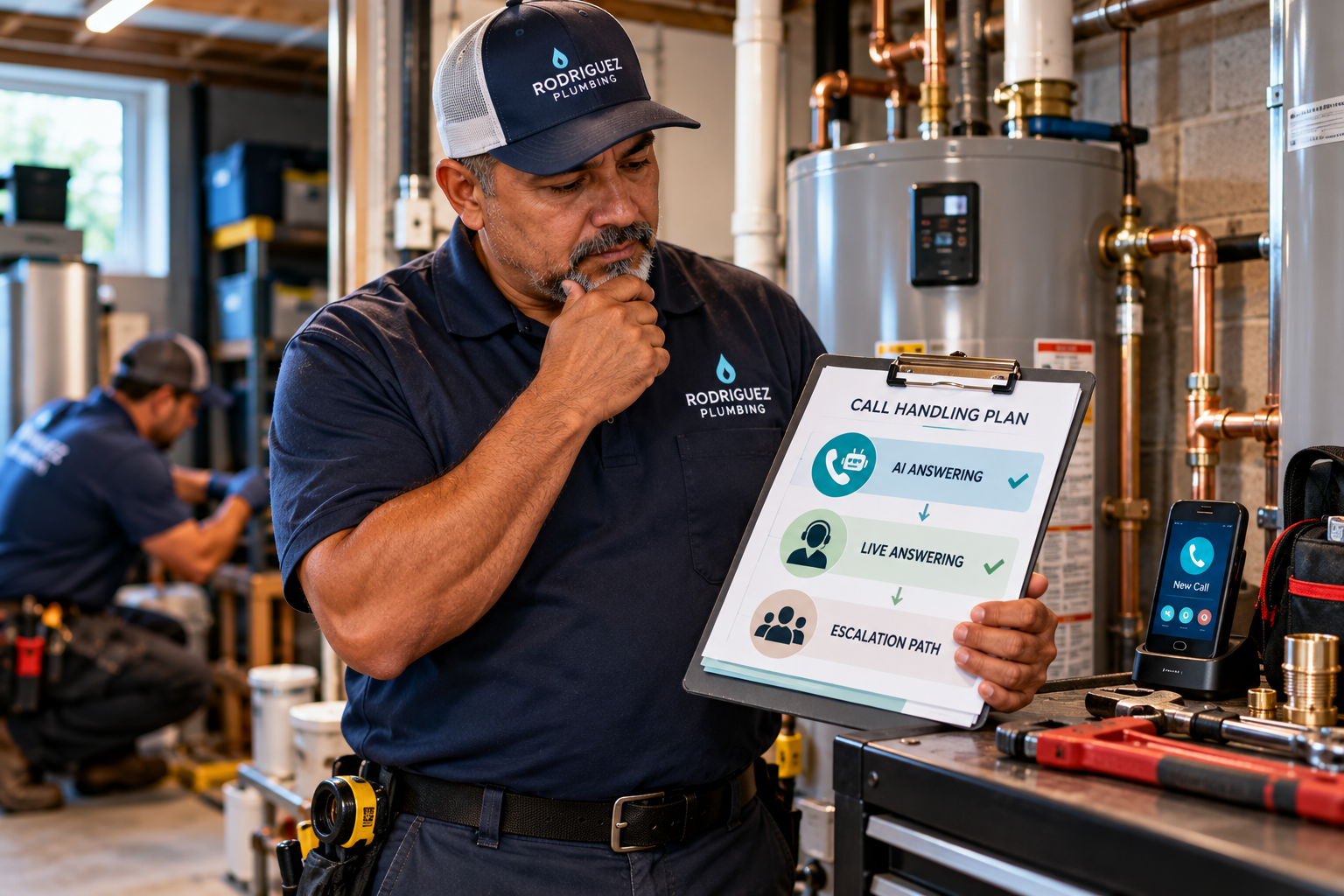
A small business answering service costs somewhere between $0 and $2,500 a month depending on who, or what, picks up the phone. For most small businesses, a plan in the $150 to $600 range covers real coverage: a live agent or AI system that answers, asks the right questions, and sends you a clean summary instead of a voicemail nobody checks until Monday.
I built EchoAssist after watching too many good businesses lose work to a missed call. The owner was on a roof, in a showing, or under a sink, doing the job that pays the bills, and that is exactly why the phone kept ringing into voicemail. An answering service exists to close that gap, whether it uses live agents, AI, or a blend of both.
EchoAssist, DH Digital’s AI receptionist, answers every call in one ring, qualifies the lead, and sends a summary straight to you, starting at $497 a month with a $397 setup fee. If you want to see how that looks for your business before committing to anything, a free 10-minute demo walks through it live.
Key Takeaways
- Answering services run from basic voicemail replacement to full 24/7 lead qualification, and the price follows the features.
- AI-based coverage tends to cost less per month than live-agent services while still answering every call.
- The right setup depends on call volume, how complex your calls get, and whether you need booking or routing built in.
What Should an Answering Service Handle for Your Business?
A good answering service does more than pick up the phone. It answers, screens, qualifies, and hands you something you can act on.
Call answering is the baseline: every call gets picked up instead of ringing out. 24/7 call answering extends that to nights, weekends, and holidays, which matters most for after-hours answering, since a 411 Locals study of 85 small businesses across 58 industries found only 37.8 percent of incoming calls were answered live over 30 days. The rest went to voicemail or nowhere at all.
From there, the service should handle:
- Call screening, so spam and solicitors get filtered out before they waste anyone’s time.
- Lead qualification, asking the questions that tell you whether a caller is a real prospect, not just taking a name and number.
- Appointment scheduling, booking directly into your calendar when the caller is ready to move forward.
- Call routing, sending urgent calls to you immediately and routine ones into a queue for later.
- Call summaries and transcripts, delivered in real time so you know what happened on every call without listening to a recording.
Speed matters here. An MIT and InsideSales study of more than 15,000 leads and 100,000 call attempts found that contacting a lead within 5 minutes made a business 100 times more likely to connect and 21 times more likely to qualify them, compared to waiting just 30 minutes. Whoever answers your phone, answering fast and capturing the right details is what turns a call into a booked job. For more on what this actually costs a business in lost revenue, how missed calls cost service businesses breaks down the math.
Which 2026 Services Fit AI, Live, or Hybrid Needs?
Answering services in 2026 fall into three categories: live, AI, and hybrid, and the right fit depends mostly on call volume and how emotionally complex your calls tend to get.
A live answering service uses trained human agents, often working from a call center, who answer using a script written for your business. Live receptionists handle nuanced or sensitive calls well, like a distressed caller or a legal emergency, which is where the higher price earns its keep. Ruby is a long-running example, built on live receptionists since 2003, with plans starting around $250 a month. AnswerConnect offers 24/7 live answering with phone, chat, and email support, starting around $269 a month for 100 minutes. Abby Connect and PATLive follow a similar model, with live agents answering under your business name.
An AI receptionist, sometimes called an ai answering service, uses conversational AI instead of a phone tree or a live agent. It holds a natural conversation, answers using your actual business information, and never takes a lunch break. EchoAssist, DH Digital’s own AI receptionist, answers in one ring, qualifies leads with business-specific questions, filters spam, and sends real-time summaries, built around a client’s actual services, hours, and booking process rather than a generic script. Smith.ai blends both approaches, pairing automation with live agents and answering roughly 95 percent of calls within the first three rings, with pricing that starts around $95 a month for a small number of calls. Quo and Moneypenny also sit in this space, combining live or AI-assisted answering with scheduling and CRM tools.
A hybrid answering service routes routine calls to AI and escalates anything that needs judgment to a person. This pattern tends to cost 60 to 70 percent less than all-human coverage while keeping quality on par, since AI handles the repetitive 80 percent (bookings, FAQs, basic qualification) and humans take the 20 percent that needs a real conversation.
| Service | Model | Starting Price | Best Fit |
|---|---|---|---|
| EchoAssist | AI, 24/7 | $497/mo + $397 setup | Real estate agents, home-service businesses, solo operators |
| Ruby | Live | ~$250/mo | High-touch industries like law and consulting |
| AnswerConnect | Live, 24/7 | ~$269/mo (100 min) | Omnichannel support across phone, chat, email |
| Smith.ai | Hybrid | ~$95/mo (2 calls) | Lead qualification with live backup |
| PATLive, Abby Connect | Live | Varies | Businesses wanting a dedicated live voice |
A virtual receptionist is the umbrella term covering all of these, live, AI, or hybrid, as long as the receptionist works remotely rather than sitting at a desk in your office. If you are weighing an AI receptionist against hiring someone in-house, ai receptionist vs hiring a receptionist walks through that comparison directly.

How Much Does Call Coverage Cost?
Answering service cost ranges from around $50 a month for basic plans to $2,500 or more for high-volume, round-the-clock live coverage, and the pricing model you choose matters as much as the provider.
Three billing structures dominate small business answering services:
- Flat-rate pricing charges one fixed fee for a defined allowance of calls or minutes. This is the most predictable model and the one most AI-based services use.
- Per-minute pricing charges a base fee plus overage rates, often $1.00 to $1.50 per minute. A 5-minute call at $1.37 a minute runs $6.85, which adds up fast with 20 or more calls a day.
- Per-call pricing charges a flat fee per call regardless of length, typically $7 to $12 per call. This suits longer calls like legal intake but gets expensive at high volume.
Live answering services for small businesses most often fall between $135 and $400 a month on entry-level plans, according to AMBS Call Center’s 2025 price guide, with higher-volume plans costing more. AI answering services typically run $200 to $600 a month for most small businesses, since flat-rate plans do not carry per-minute overage risk.
EchoAssist runs $497 a month with a one-time $397 setup fee, and the first 10 founding clients lock in $297 a month for one year in exchange for a testimonial. There is no long-term contract; billing is month to month.
Watch for hidden fees before signing anything: setup charges ($50 to $200), holiday surcharges (1.5x to 2x rates), after-hours premiums, and transfer fees ($1 to $3 per call). Ask for a complete fee schedule, not just the advertised base price. opportunity cost unanswered calls lays out how to weigh the monthly bill against what a missed call actually costs you.
How Do You Set Up Calls So Leads Get a Clear Next Step?
Every answering service setup should end with the caller knowing exactly what happens next, whether that is a booked appointment, a transfer to you, or a promise of a callback with a real timeframe.
Start with custom call scripts built around your actual business, not a generic template. A script should confirm the service type, whether the caller is in your coverage area, how urgent the request is, and the best callback number, in that order. Jason Aleman of Gutter Cowboy put it this way: “It’s almost every day that I lost a job due to not answering the phone.” A tight script is what turns that kind of loss into a booked job instead.
From there, build out:
- Call forwarding and call transfers, so urgent calls reach you immediately instead of sitting in a queue.
- CRM integration, so lead details land in your system automatically instead of getting retyped by hand.
- Appointment booking, so a ready caller gets scheduled on the spot rather than waiting for a callback.
- Emergency dispatch rules, so a plumbing leak or an electrical hazard gets flagged and routed differently than a pricing question.
- Bilingual support, if a meaningful share of your callers speak Spanish or another language.
- Message taking, for the calls that genuinely just need a note passed along.
The goal is a system that asks the right questions once, routes based on what it learns, and never leaves a caller guessing. For a deeper look at what your receptionist setup needs to know before it takes its first call, ai receptionist setup what it needs to know covers the specifics.
Choosing Coverage That Fits the Way You Work
The right business answering service matches your call volume, your budget, and how much judgment a typical call requires, not the flashiest feature list.
If most of your calls are routine, after-hours coverage of simple service requests, an AI receptionist like EchoAssist handles that work at a flat monthly rate without per-minute surprises. If your calls regularly involve legal intake, medical triage, or high-stakes emotional situations, a live or hybrid service earns its higher price by putting a trained person on the line when it counts.
Either way, a phone answering service for small business should let you keep control. EchoAssist is built around each client’s real services, coverage area, hours, and escalation rules; it documents and routes calls, it does not negotiate price or make judgment calls you have not authorized. That keeps you in charge of the business relationship while the system handles the front door.
Solo operators and small service teams tend to do best starting simple: one coverage window, one set of qualifying questions, one clear escalation path for anything urgent. Add complexity, like bilingual support or emergency dispatch, once the basics are running well. If you are the only one answering the phone right now, ai receptionist one person business is worth a look before you commit to a plan. A free 10-minute demo is also available if you want to see how EchoAssist would handle your actual call flow before signing up.
Conclusion
An answering service for your small business should match the way your calls actually come in, routine daytime questions, after-hours emergencies, or everything in between. Live services earn their cost on complex, emotionally sensitive calls, AI receptionists like EchoAssist cover routine and after-hours volume at a flatter monthly rate, and hybrid setups split the difference. Whatever you choose, the measure that matters is simple: does every caller get a clear next step, or does the call just disappear into voicemail.
Frequently Asked Questions
What is the cheapest answering service for a small business?
Basic voicemail-style plans can run as low as $50 a month, but they usually only take a message rather than qualifying the lead. AI answering services tend to offer the best value for the price, often $200 to $600 a month, since they include 24/7 coverage without per-minute overage charges.
Is an AI answering service as good as a live receptionist?
For routine calls like bookings, FAQs, and basic qualification, AI answering services perform on par with live agents at a lower cost. For highly emotional or complex calls, such as legal intake or medical situations, a live receptionist’s judgment is harder to replace.
Can I switch from voicemail to an answering service without losing my phone number?
Yes. Most answering services, including AI receptionists, let you keep your existing business number and simply route calls through the new service. Customers typically do not notice a disruption beyond faster pickup and less hold time.
Does an answering service work for after-hours calls only?
Yes, many businesses use an answering service only for after-hours, weekend, or overflow coverage while staff handle calls during business hours. Others use it around the clock so every call gets answered the same way, day or night.
How do I know if I need appointment booking built into my answering service?
If callers regularly ask to schedule a job or appointment on the spot, booking integration prevents drop-offs that happen when a caller has to wait for a callback. If most of your calls are general questions rather than ready-to-book requests, a plan with message taking and lead qualification may cover your needs without the added cost.