

A buyer persona template gives you one page to capture who your ideal customer actually is: their pain points, how they decide, and what pushes them to finally pick up the phone. For service businesses, that single page can be the difference between marketing that gets ignored and messaging that sounds like you read the customer’s mind.
I built EchoAssist for real estate agents and home-service businesses, and the pattern is the same across every one of them. The agents and contractors who book the most jobs are not the ones with the flashiest ads. They are the ones who know exactly who they are talking to before the phone even rings. A completed buyer persona template puts that knowledge in writing instead of leaving it in your head, where it is hard to share with anyone else on your team. If you want help turning that research into marketing that actually converts, DH Digital Consulting works with service businesses on exactly this kind of targeting through our customer personas service.
Key Takeaways
- A strong persona template captures pain points, buying triggers, and decision-making style, not just age and income.
- Real customer evidence, not guesswork, is what separates a usable persona from a filing-cabinet document.
- The real payoff shows up when the persona shapes your marketing, your sales calls, and how fast you respond to the lead in front of you.
What Should Your Buyer Persona Include?
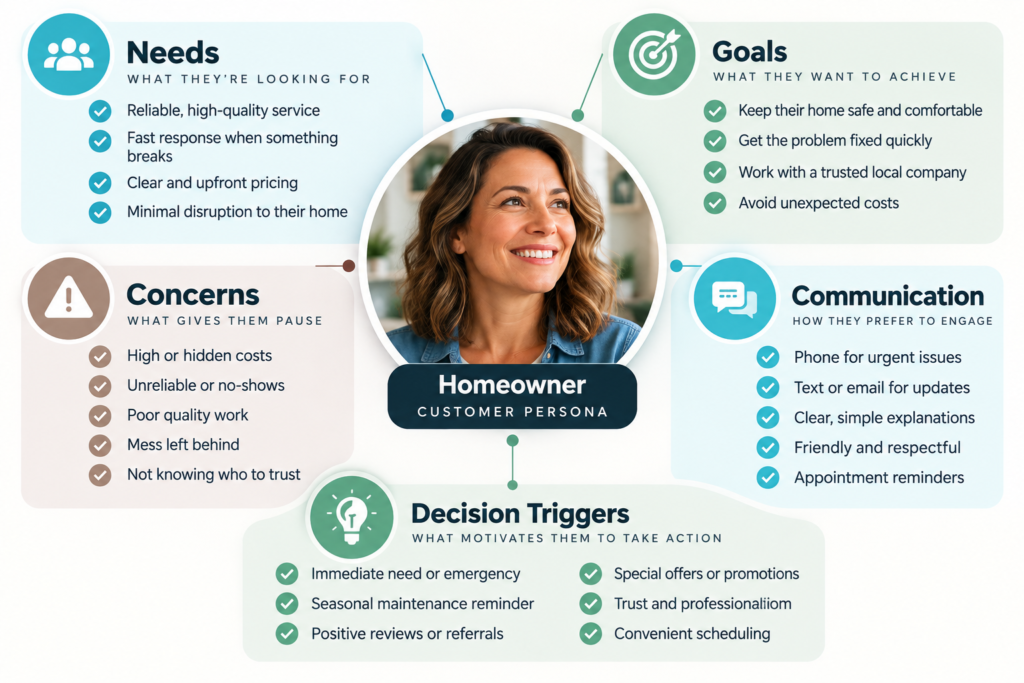
A buyer persona profile should cover eight things: demographics, pain points, buying triggers, psychographics, decision-making process, information sources, communication preferences, and a negative persona. Skip any one of these and the document turns into a demographic sketch instead of a tool that changes how you talk to customers.
Demographics and role. Age range, location, household income, and for B2B service work, job title or business type. This is the easy part and the least useful on its own.
Pain points. The specific frustration that makes someone search for a solution right now. “Needs a plumber” is a category. “Already called two companies that never called back” is a pain point you can write copy around.
Buying triggers. The event that starts the search. A burst pipe, a lease ending in ninety days, a kitchen that finally feels too dated to live with. Triggers tell you when to show up, not just who to target.
Psychographics. Values, worries, and the emotional stakes behind the purchase. A homebuyer who wants a specific school district behaves differently from one chasing a short commute.
Decision-making process. Solo decision, or does a spouse, business partner, or lender weigh in? How fast do they move once they start looking?
Information sources. Where they go first: Google, a neighbor’s recommendation, a Facebook group, a real estate agent’s listing.
Communication preferences. Phone, text, or email, and how fast they expect a reply.
Negative persona. Who you do not want: price shoppers with no loyalty, leads far outside your service area, or people who call just to price-compare with no intent to book.
How Do You Fill It Out with Real Customer Evidence?
You fill out a buyer persona template with customer interviews, CRM data, and website analytics, not assumptions about what your ideal customer probably thinks. Market research built on guesswork produces a persona that reads well and predicts nothing.
Start with quantitative data, because it tells you who is already showing up.
- CRM data. Pull your closed deals from the last twelve months. What service types, neighborhoods, or job sizes appear most often among your best customers?
- Website analytics. Which pages get the most traffic, and which ones lead to a booked call instead of a bounce?
- Call logs or voicemail transcripts. What questions do callers ask before they even get to pricing?
Then layer in qualitative research, because numbers tell you what happened but not why.
- Customer interviews. Talk to five to ten recent customers. Ask what almost stopped them from calling, and what finally made them pick up the phone.
- Sales or front-desk feedback. The person answering your phone hears the same objections and questions over and over. That repetition is a pattern worth documenting.
Look for behavioral patterns across both sources. If three different data points point to the same frustration, that frustration belongs in the persona, written in the customer’s own words whenever possible. A quote like “I missed one call and just figured I’d deal with it tomorrow” is more useful in your messaging than any paraphrase you could write yourself.
What Does a Completed Service Business Persona Look Like?
A completed service business persona reads like a short profile of one real person, built from patterns across many customers, not a spreadsheet of averages. Here is what that looks like for two common buyer persona examples in the real estate and home-service space.
B2C buyer persona example: “First-Time Buyer Fiona.” Age 29 to 34, dual-income household, renting for the last six years. Pain point: overwhelmed by the process and worried about missing a good listing. Buying trigger: a lease renewal notice with a rent increase. Decision-making process: joint decision with a partner, moves fast once pre-approved. Information source: Zillow first, then asks a coworker for an agent referral. Negative persona: browsers with no pre-approval and no timeline, testing the market more than six months out.
B2B buyer persona example: “Property Manager Paul.” Manages 40 to 80 rental units, needs a reliable vendor for repeat repair calls. Pain point: contractors who do not answer after hours during an emergency. Buying trigger: a bad experience with a no-show vendor. Decision-making process: solo decision for routine work, needs owner sign-off above a dollar threshold. Communication preference: text first, call only for emergencies.
Both personas fit inside a broader ideal customer profile (the type of account or household that fits your service area and price point) while describing the individual who actually picks up the phone or hires the vendor. Customer behavior drives every field; the name and narrative are just the wrapper that makes the data memorable for your team.
How Do You Use the Persona to Win Better-Fit Leads?
You use a buyer persona by building every marketing campaign, sales conversation, and customer journey map around the pain points and triggers it documents, instead of writing generic messaging and hoping it lands. A persona sitting in a folder changes nothing. A persona referenced during content creation and sales calls changes everything downstream of it.
In content creation, write directly to the trigger. If “First-Time Buyer Fiona” starts looking after a rent increase, a blog post or ad about rising rent costs will outperform a generic “thinking of buying a home” headline every time.
In sales enablement, give your team the objections before the prospect raises them. If property managers worry about after-hours response, address it in the first email, not the fifth.
In your customer journey map, plot where each persona drops off. A first-time buyer might stall at financing questions; a property manager might stall waiting for a callback that never comes.
The business impact shows up in measurable places:
- Conversion rates. Messaging that matches a real pain point converts better than messaging written for “anyone who needs our service.”
- Marketing ROI. Budget spent on the channels your personas actually use, instead of every channel at once.
- Customer service and experience. Front-line staff who know what a caller likely needs before the caller finishes explaining it.
None of this works if the lead never gets a response. A well-built persona tells you who to target; a service business lead path guide helps make sure that person actually gets through to you once they call.
Keep Your Persona Grounded in Real Calls
The biggest mistake I see service businesses make with a buyer persona template is filling it out once and never checking it against what actually happens on the phone. A persona built from six-month-old assumptions drifts away from reality fast, especially in real estate, where buyer behavior shifts with interest rates and inventory.
Every call your business gets is a small piece of evidence. The questions callers ask, the objections they raise before booking, and the words they use to describe their problem all belong back in your persona document. This is where a lot of solo operators and small teams lose the thread. You are out doing the work that earns the money, the job that is the whole reason someone is calling you in the first place, and that is exactly why the call that could confirm or correct your persona goes to voicemail instead of getting captured.
That gap is the problem EchoAssist was built to close. It answers every call, asks the qualifying questions you have already decided matter, and sends you a real-time summary of what the caller said in their own words. Instead of losing that raw material to a missed call, you get it delivered to your phone, ready to feed straight back into your persona. The standard plan runs $497 a month with a $397 setup fee, month to month with no contract. I am also offering a founding rate of $297 a month, locked for one year, to the first ten clients in exchange for a testimonial. You can see how the setup works and book a free ten-minute demo through the EchoAssist page.
A persona that reflects what callers actually say will always beat one built from a single afternoon of guessing, and the easiest way to keep it accurate is to make sure every call gets captured in the first place.
Frequently Asked Questions
What is the difference between a buyer persona and an ideal customer profile?
A buyer persona describes the individual person who makes or influences the buying decision, including their goals, objections, and communication habits. An ideal customer profile describes the type of account or household that fits your business best, such as location, budget range, or property size. You typically have one ideal customer profile with several buyer personas inside it, since different people at or around that profile have different concerns.
Should I use Google Docs, Canva, or a dedicated tool to build my persona?
Google Docs works well if you want something simple, shareable, and easy to update as new customer evidence comes in. Canva suits teams that want a polished, presentation-ready layout to share with partners or stakeholders. Either tool works fine as long as the fields themselves, pain points, triggers, and decision-making style, actually get filled in with real research.
Are free buyer persona templates good enough, or do I need a custom one?
Free buyer persona templates are a solid starting point, since most cover the same core fields: demographics, goals, pain points, and buying behavior. The template format matters far less than the research behind it, so spend your time on customer interviews and CRM data rather than searching for the perfect template design. A plain one-page document filled with real quotes beats a polished template filled with guesses.
How many buyer personas does a small service business need?
Most small service businesses need two to four distinct personas, not one universal profile that tries to cover everyone. A real estate agent, for example, might need separate personas for first-time buyers and move-up sellers, since their triggers and timelines differ. Building more than four usually spreads your marketing too thin to execute well.