

A missed call costs a real estate agent more than a few minutes of hassle. It costs the lead entirely, because the next name on that buyer’s list picks up. Social media is where agents win those buyers back before the phone even rings, by showing up consistently enough that a prospect calls them first. The right social media content ideas for real estate agents turn a phone that often goes unanswered during showings into a pipeline that keeps feeding itself.
I built this list around posts that actually move a transaction forward: content that sells a specific listing, proves local knowledge, and gives a prospect a clear reason to pick up the phone. Each idea below works on Facebook, Instagram, or both, and none of it requires a video crew or a design degree.
If a post does its job and the phone starts ringing at the wrong moment, that’s its own problem worth solving. EchoAssist answers every call in one ring, qualifies the lead, and sends a summary so no post-driven inquiry goes to voicemail. You can book a free 10-minute demo any time to see how that works alongside your posting schedule.
1) New Listing Walkthrough With Three Buyer-Relevant Details
A new listing post works when it answers questions before a buyer has to ask. Pick three details that actually matter to a buyer’s decision: updated kitchen appliances, a finished basement, a two-car garage, a recent roof replacement. Skip generic praise like “stunning” or “must-see.”
Film a short walkthrough video or post a tight photo carousel, and put those three details in the caption as a simple list. Buyers scrolling fast will read the caption before they watch thirty seconds of video, so front-load the information that would make someone stop and ask about a showing.
This post works on Facebook and Instagram equally well. On Facebook, longer captions perform fine. On Instagram, keep the caption short and let the first photo carry the hook, with details in a follow-up slide.
End with a direct next step: “DM me to schedule a tour” or “Open house this Saturday, details in my next post.” A listing post without a next step is just a photo album.
2) Open House Preview With the Time, Location, and Next Step
An open house preview exists to get bodies through the door, so lead with the logistics, not the atmosphere. State the day, start and end time, and full address in the first line of the caption. Buyers decide whether to attend in the first few seconds of reading, and vague details lose them.
Pair the logistics with two or three photos that show the home’s best room and its curb appeal. A short video walking from the driveway to the front door works well here too, since it gives attendees a preview of what they’ll see when they arrive.
Close with a concrete next step: “Can’t make it Saturday? Message me for a private showing” or “RSVP in the comments so I know who to expect.” That line turns a passive scroll into an action, and it gives you a reason to follow up with anyone who responds.
Post this one two to three days before the open house, then again the morning of. The second post catches people planning their Saturday.
3) Neighborhood Tour of Amenities and Daily Errands
A neighborhood tour sells the area before anyone commits to a specific address, because most buyers choose a neighborhood first and a house second. Walk or drive the route a resident would actually take: the coffee shop, the grocery store, the park, the school drop-off route.
Film it in one continuous take if possible, since a single unedited clip feels more honest than a polished montage. Narrate plainly: “This is the walk to the elementary school, about eight minutes from the front door” or “Grocery run from this street takes under ten minutes round trip.”
Specific, timed details beat vague descriptions like “close to everything.” A buyer weighing two neighborhoods will remember the one where an agent showed the actual commute or errand run instead of just saying it’s convenient.
This content works well as a recurring series, one neighborhood at a time, which gives you a reason to post weekly without needing a new listing. It also builds a library you can point future clients to when they ask about a specific area.
4) Monthly Local Market Snapshot With One Clear Takeaway
A market update post works when it gives one number and one plain explanation, not a wall of statistics. Pick the metric that matters most to your audience that month: median sale price, average days on market, or current inventory levels for your area.
State the number, then explain what it means in one sentence. “Median price in Oak Hollow is up four percent from last month, which means sellers in that area have more room to negotiate on repairs” tells a reader something they can use. A chart with five metrics and no explanation does not.
Keep this post to your specific city, ZIP code, or subdivision rather than a national or state-level statistic. Hyperlocal numbers carry more weight with buyers and sellers deciding whether to act this month, and they’re harder for a competing agent to copy without doing the same local research.
Post this once a month on a set schedule, Facebook and Instagram both. Readers who see it land in their feed on a predictable cadence start checking for it, which builds a habit loop that keeps your name in front of them between transactions.
5) Buyer FAQ on Preapproval Before a Showing
A preapproval post removes one of the biggest points of confusion for buyers before they ever call an agent. Explain plainly what preapproval means, why a lender needs it before a showing, and how long the process usually takes.
Keep the explanation short: what documents a buyer needs, the rough timeline, and the difference between preapproval and prequalification if that distinction matters in your market. Avoid jargon a first-time buyer wouldn’t recognize.
This post works as a short video with you speaking directly to the camera, or as a simple graphic with three or four bullet points. Either format should end with a direct offer: “Message me and I’ll connect you with a lender I trust” or “Send me a question and I’ll answer it in my next post.”
Preapproval content earns trust because it answers a real concern before a prospect has to admit they don’t understand the process. It also filters serious buyers from casual browsers, since someone who messages about preapproval is closer to ready than someone just liking photos of homes.
6) Seller Checklist for Preparing a Home to List
A seller checklist gives a homeowner a reason to call before they’ve picked an agent. Break the prelisting process into five or six concrete steps: declutter each room, handle minor repairs, deep clean carpets, address curb appeal, and schedule professional photos.
Present it as a simple numbered list in a carousel post or a single graphic, not a long paragraph. Sellers skim this kind of content looking for something they can act on immediately, so short, specific steps beat a general overview of “getting your home ready.”
Include one detail that shows local knowledge, like a repair issue common in your area’s older housing stock or a staging choice that tends to sell faster in your market. That detail separates the post from a generic checklist anyone could find with a search.
Close with an invitation: “Thinking about listing in the next few months? Send me a message and I’ll walk through your home with you.” This post works well a few months ahead of your area’s typical selling season, when homeowners start thinking seriously about a timeline.
7) Before-and-After Photos of Listing Preparation
Before-and-after photos prove the value of preparation work in a way words cannot. Use a split-screen or side-by-side format showing the same room or exterior angle before staging, repairs, or a deep clean, and after.
Pick a dramatic but honest transformation: decluttered countertops, fresh paint on a dated accent wall, a lawn mowed and edged for the first time in months. Avoid staged-looking “after” photos that feel unrealistic, since buyers trust transformations that still look like a lived-in home.
Add a short caption explaining what changed and why it mattered to the sale. “Removed the oversized sectional and repainted this wall; the home went under contract nine days after these photos were taken” gives the post a result, not just a visual.
This content does double duty. It shows current followers your attention to detail on an active listing, and it gives a future seller proof that small changes affect how fast a home moves. Save a few strong examples to reuse when pitching a seller on staging later.
8) Short Video Answering a Question Heard at Showings
A short video answering a real question turns something you already explain in person into content that reaches hundreds of people. Pick a question buyers or sellers ask you repeatedly: “Do I need 20 percent down?” or “What happens if the inspection finds something?”
Answer it in sixty to ninety seconds, speaking directly to the camera in plain language. Skip the setup and skip restating the question for thirty seconds before answering it; say the answer first, then explain the reasoning behind it.
This format works because it comes from a real conversation rather than a researched topic, which makes the delivery sound natural instead of scripted. Viewers can tell the difference between an agent explaining something they’ve said a dozen times and one reading from a script.
Keep a running list of these questions on your phone as they come up during showings and calls, so you always have the next few videos planned. Close each one with a simple invitation to send in a question for a future post, which keeps the series running on its own.
9) Client Closing Story Shared With Permission
A closing story works because it shows a real result instead of claiming one. Ask the client directly if they’re comfortable being featured, and get their permission before posting any photo, quote, or detail about their transaction.
Tell the story with specifics: what the client was looking for, a challenge during the search or negotiation, and how it resolved. “Found them a home with the yard they wanted after their first two offers lost in multiple-offer situations” gives a reader something concrete, far more than “another happy client.”
A short video of the client at their closing table or in front of their new home, paired with a quote in their own words, carries more weight than a polished testimonial written entirely in your voice. Let them describe the experience, even if the language isn’t perfectly polished.
Tag the client if they’re willing, since they may reshare the post to their own network, which extends your reach past your existing followers. This content builds trust with prospects who are still deciding whether to work with you at all.
10) Just-Sold Post Explaining the Pricing Decision
A just-sold post proves your pricing strategy worked, which is the exact skill a future seller is evaluating. State the result plainly: days on market, whether it sold at, above, or below list price, and one sentence on why that pricing approach worked for that property.
Avoid vague wins like “another one sold.” Specifics like “priced at market value based on three recent comps, received two offers within the first week” show the reasoning behind the result, not just the outcome.
If the home sold quickly, explain what made that possible: condition, location, or timing relative to other inventory in the area. If it took longer than average, a brief, honest note about market conditions at the time builds more credibility than silence on the timeline.
Tag the clients if they’re comfortable with it, and include a photo from the closing or the yard sign coming down. This post works well paired with the closing story format above, but keep the focus here on the pricing and negotiation outcome rather than the emotional side of the sale.
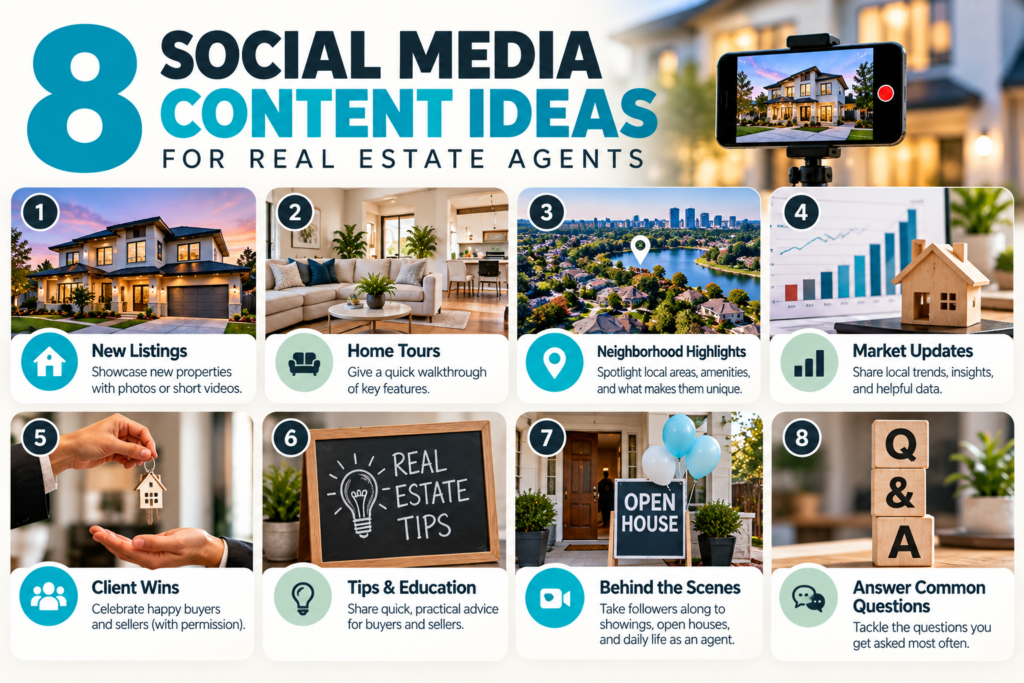
Choose a Posting Schedule You Can Maintain
A posting schedule only works if it survives a busy week of showings and closings. Pick a frequency you can sustain for months, not one that looks ambitious on paper for the first two weeks and then disappears. Posting twice a week consistently builds more trust than posting daily for a week and going quiet for a month.
Start with one platform where your current clients and sphere of influence already spend time. Trying to run Facebook, Instagram, and TikTok at the same level of effort from day one usually means all three suffer. Once a schedule on one platform feels manageable, expanding to a second platform makes sense.
Build a simple content pillar system from the ten ideas above: rotate through listing content, neighborhood or market education, and client stories so no single post type dominates your feed. A content calendar with specific dates, even a basic spreadsheet, removes the blank-caption problem that stalls most agents before they start.
Batch similar content when possible. Filming three neighborhood tours in one afternoon, or writing four market update captions in one sitting, saves time compared to creating each post the day it goes out. Review what’s getting saved, shared, or commented on each month, and adjust the mix toward whichever pillar performs best for your audience.
Make It Easy to Respond When a Post Prompts a Call
A post that drives a phone call only pays off if someone answers it. Agents working in the business all day, showing homes, meeting inspectors, driving between appointments, often cannot pick up when a lead from a well-performing post calls in. That missed call becomes a lost lead the moment the prospect dials the next agent on their list.
Make the call-to-action in each post specific enough that a prospect knows exactly what happens next, whether that’s “message me,” “call for a private showing,” or “comment and I’ll follow up.” Vague calls to action like “reach out anytime” generate less response because they don’t tell a prospect what to expect.
Decide in advance how you’ll handle calls that come in while you’re unavailable. A full voicemail box sends a serious buyer straight to a competitor, and a text reply sent six hours later often arrives after that buyer has already called someone else. EchoAssist answers in one ring around the clock, asks the qualifying questions tailored to your business, and sends you a real-time summary so you know exactly who called and why before you call back. The standard plan runs $497 a month with a $397 setup fee, month to month with no long-term contract, and the first ten founding members lock in $297 a month for a full year in exchange for a testimonial.
Frequently Asked Questions
Which real estate post ideas work best on Facebook?
Longer-form content performs well on Facebook, including detailed market updates, full client success stories, and open house announcements with complete logistics in the caption. Facebook’s audience tends to skew toward past clients and local community members, so neighborhood content and local business shoutouts also do well there.
What should a real estate agent post on Instagram besides listings?
Instagram rewards short videos, neighborhood tours, before-and-after transformations, and quick buyer or seller tips delivered in sixty seconds or less. Carousel posts with three to five slides work well for checklists, like the seller preparation list, since Instagram users expect to swipe through quick visual content rather than read long captions.
How can agents create real estate social media posts without paying for templates?
A smartphone camera, natural lighting, and a simple script of three talking points cover most of the formats on this list, including listing walkthroughs, neighborhood tours, and FAQ videos. Free photo editing apps and the native caption tools on Facebook and Instagram handle the rest without requiring a paid design subscription.
How often should a real estate agent post on social media?
Two to three posts a week on a single platform, maintained consistently for months, builds more trust than daily posting that stops after a few weeks. Pick a frequency that fits around showings and closings, since a schedule that collapses during a busy week does more harm than a modest one kept on track.
What should an agent do when someone calls after seeing a post?
Answer the call if possible, since a prospect who just saw a compelling post is at their highest point of interest and will move on to another agent if the call goes unanswered. For calls that come in during a showing or after hours, a service like EchoAssist can answer in one ring, qualify the lead with questions specific to your business, and send a summary so the follow-up happens with full context.